I'm Maria, a psychologist and behavioral designer. I help teams use what we know about human behavior to build products and interventions people keep using, and that truly improve their quality of life.
For health tech, MedTech and any organization that needs people to change behavior, from one product to large-scale programs.
Based in the Netherlands. I work with teams internationally and travel when a project needs it.
About me
How I got here
Psychologist by training, designer by choice. What I bring that most designers don't: a deep understanding of the brain and human behavior.
BSc in Psychology
2 MScBehavioral Science ResearchHealth Psychology and Digital Interventions
3+ yearsin Dutch and UK digital health
Chapter 1
The spark
A professor told me this during my BSc in Psychology:
“Good tech teams have developers. The best ones also have a psychologist. But they are almost always two different people, and each one thinks their part matters most. The ideal would be someone who understands both worlds.”
I decided to become that person.
BSc in Psychology, University of Granada
Chapter 2
Learning from people
I worked as a psychologist with very different groups, such as adults with intellectual disabilities and mental illness, and children with autism. It taught me that what you learn from books is not enough.
To make anything work, you have to center it on the person receiving it, and tailor it to them and their situation.
Clinical and community psychology, Spain
Chapter 3
Eager to learn: 2 MSc
First, research in behavioral science.
Then Rotterdam, where I finally found a way to bring both worlds together: technology that influences people's behavior, but used for good, to improve their quality of life.
MSc Behavioral Science Research, University of Almería MSc Health Psychology and Digital Interventions, Erasmus University Rotterdam
Chapter 4
Both worlds, together
Today, I'm the person that professor said teams needed.
I helped improve the Dutch national lifestyle program for people with obesity. I designed a patient app for UK primary care, from start to finish, that turns patients from passive to active in caring for their health. And I train MedTech teams on why people adopt new technology, and why they don't.
Health Tech Studio, based in the Netherlands
My services
How I can help
Every product or program asks people to do something. Take a test, change a habit, come back tomorrow. I help you design for that moment.
1
Work with me on your product
Wherever your product is, I help you build it around real people.
Where is your product right now?
Choose a stage to see how I can help
User diagnostic
Not sure what your users really need?
I talk with the people who will use it and the people around them, observe how they live and work, and turn it into requirements your team can build on.
How we work together
AlignWe start with your questions, your users and what you already know.
Listen and observeInterviews and observation with your users and the people around them, such as professionals, caregivers or buyers.
Make sense of itI turn what I hear into needs and requirements, and walk your team through them.
What you get
Clear user needs and pain points, prioritized
Requirements your team can build on
A map of your users' current experience
A session with your team to turn findings into decisions
A good fit if you have an idea or early concept and want to be sure it solves a real problem before investing in development.
Sometimes the best help is teaching your team to do it themselves.
Learn what you must get right when you design or roll out a product, so it truly works for the people who use it. It may feel like more work at the start. In the long run, the mistakes you avoid save you time and money.
For any team
Product and design
R&D (research and development)
Sales
Healthcare and care teams
Leadership
Topics I teach
Pick a topic to see what it covers. Sessions can combine several.
Understand people
Design for real behavior
Keep people engaged
Make it work in the real world
Health in focus
Behavior changeWhy people do or don't change, and how to design for it.
Two different projects. Both start with the same question: what needs to change in a person's behavior?
UK primary care · Patient app
Ongoing project
Helping patients take the lead in their own care
Patients wait to be called, and practices spend hours chasing them. I mapped more than 40 patient behaviors and designed each key screen around one of them.
Three problems I solved. Pick one to see the screen.
The resultA patient app that puts patients in charge, now being rolled out with GP practices.
Good morning, Sam
2 actions need you now.
Needed now
!
Blood testWas due in May
Book
!
Blood pressureTakes 5 minutes
Book
Due this month
◷
Smoking and alcohol2-minute quiz
Start
Up to date
✓
Eye screeningBooked for 14 March
TodayMy healthProfile
Every action in one place, ready to book.
Today
2 of 5 habits done today
Your heart age58
Your age52
Every habit counts. Your next blood test will show it.
✓Walk 15 minutes
✓Water with lunch
◯Less salt at dinner
◯5 minutes of slow breathing
◯In bed by 23:00
A far-away risk, visible today.
Your results › Blood sugar (HbA1c)
▲Slightly out of range
In rangeSlightly outOut of range
3 of 3 · What you can do
Small changes add up. Pick one to start this week:
Take the stairs when you can
Swap one sugary drink for water
Go to bed 30 minutes earlier
Add to my plan
What it is, why it matters, what you can do.
Client
A UK digital health company in primary care
My role
Digital Health Product Owner, design end to end
Since
April 2025
The starting point
Between 2013 and 2023, the number of GP (general practitioner) practices in England fell by 20%. In the same years, the average number of patients per practice grew by 40% (Pettigrew et al., BMJ Open, 2024). Staff have less time, and patients wait longer.
In this system, the patient usually has a passive role. Practices chase patients to book blood tests and check-ups, because part of their funding depends on those checks getting done. Patients wait to be called, or go only when something hurts.
I designed a patient app for people with heart, kidney and metabolic conditions that changes this. I led it from the first research to the final screens, with clinicians, a clinical safety expert and developers.
How I worked
Every problem went through the same five steps: understand, define, design, bring to practice, and evaluate. I started wide.
Surveys with patients, clinicians and practice staff
In-depth interviews with patients of different ages
What patients share about their care in online forums
Reviews of the scientific literature
A review of existing apps, like the NHS (National Health Service) App, MyChart and Doctolib
40+ behaviors that keep patients from looking after their health, mapped with what helps and what gets in the way.
I chose the behaviors with the biggest impact. Then, for each one, I looked at what people need to know, what in their daily life blocks them, and what drives or stops their motivation. Here are three of those problems, one at a time.
Problem 1The practice chases the patient
Understand
I looked at both sides, and found a loop.
Patients didn't know which checks were due, or when. When they tried to book, they had two options. By phone, the lines were so busy they could wait up to an hour. Online, they had to fill in a very long questionnaire, and often still didn't get an appointment at the end. Many stopped trusting it. A third of the patients surveyed found digital booking confusing, and a third only contacted their practice in an emergency. So many put their checks off for as long as they could, sometimes until their health got worse. As one patient said: "I spend more time chasing up results than managing my health."
Practices lose part of their funding when checks are missed. So staff spend hours chasing patients. But every hour spent chasing is an hour not answering the phone, so the lines get even busier.
PatientDoesn't know which checks are due, or when.
PatientLong phone waits, or a long online form that often ends with no appointment. So checks get put off.
PracticeMissed checks mean missed targets and less funding, so staff chase patients.
PracticeTime spent chasing is time not answering calls. The lines get busier.
→↓←↑↻
Define
The behavior to change: book and attend routine checks when they are due. People don't skip checks because they don't care. They forget when checks are due. They don't see why they matter when they feel fine. And booking feels like a hassle. Being "overdue" can even feel like a telling-off, which makes people avoid it more. To break the loop, the app had to show what is due, let people book without a phone call, and remind without blaming.
Design
A to-do list for your health, right on the home screen. Every clinical action in one place: a blood test, a short questionnaire about smoking or alcohol, a weight check. Actions are grouped by when they are due. Patients book straight from the action, with no phone call. Reminders are friendly and never blame.
Bring to practice
Now being rolled out with GP practices. When patients complete their own actions, practices meet more of their targets without staff chasing anyone. Patient care and practice funding finally point in the same direction.
Evaluate
What I will measure: the share of due checks booked and completed through the app, the time between a reminder and a booking, and staff time spent on recall calls and letters.
Good morning, Sam
2 actions need you now.
Needed now
!
Blood testWas due in May
Book
!
Blood pressureTakes 5 minutes
Book
Due this month
◷
Smoking and alcohol2-minute quiz
Start
Up to date
✓
Eye screeningBooked for 14 March
TodayMy healthProfile
Every action in one place, ready to book. Illustrative mockup with example content, not the real product.
Problem 2Future risk feels far away
Understand
Most patients thought that taking the pill their GP prescribed for a high marker was enough. Few knew they could do anything else. They didn't see that their daily habits have a direct effect on their risk, and that better habits are proven to lower it, sometimes even more than medication. And with heart conditions, the consequences come years later, so today's choices feel like they don't matter.
Define
The gap was in what people believe about consequences. They needed to feel, today, that their daily choices count. But fear makes people look away. So the solution had to make risk visible, give hope, and show progress right away.
Design
An avatar that shows the age of your heart, based on a clinical risk score used in the UK (QRISK3). Its daily version reacts to your habits: happy when you complete them, low on energy when you don't. Your heart age updates when new test results arrive. No points, and no comparing with others. After the result, a positive screen reminds you that there is always something you can do.
Bring to practice
Risk messages reviewed with the clinical team. Planned for a later release.
Evaluate
What I will measure: daily habit completion, how often people come back to the app, and the change in heart age between blood tests.
Today
2 of 5 habits done today
Your heart age58
Your age52
Every habit counts. Your next blood test will show it.
✓Walk 15 minutes
✓Water with lunch
◯Less salt at dinner
◯5 minutes of slow breathing
◯In bed by 23:00
A far-away risk, visible today. Illustrative mockup with example content, not the real product.
Problem 3Lab results that read as numbers, not as real life
Understand
Getting the results was not the problem. Understanding them was. Patients saw numbers they could not read, and felt the next step belonged to their doctor. If the doctor prescribed a pill, that was it. Few thought about the many things they could do themselves. As one patient put it: "When you get the results in… you are left hanging. The power is all with the clinician."
Define
A number on its own, with no explanation and no link to daily life, means very little. "Your eGFR (estimated glomerular filtration rate) is 52" is hard to understand. "Your kidneys are not cleaning your blood as well as they should, but there is still time to do something about it" is not. People needed to understand their result, know what it means for their everyday life, and have one thing they could do about it. In simple words, and without alarm.
Design
Up to five key markers from the patient's blood tests, each explained in three short cards: what it is, why it matters, and what you can do. Every number is translated into plain words about the body and everyday life, and always ends with what is still possible. Every result leads to small habits across six pillars of health: nutrition, activity, sleep, stress, risky substances and social connection.
Bring to practice
Part of the first release, now being rolled out. As it connects with the new medical platforms being built, I expect it to help patients take more ownership of their health, moving from a passive role to an active one.
Evaluate
What I will measure: whether patients show more interest in their own health after seeing their results, and whether they use the lifestyle and habit features more.
Your results › Blood sugar (HbA1c)
▲Slightly out of range
In rangeSlightly outOut of range
3 of 3 · What you can do
Small changes add up. Pick one to start this week:
Take the stairs when you can
Swap one sugary drink for water
Go to bed 30 minutes earlier
Add to my plan
What it is, why it matters, what you can do. Illustrative mockup with example content, not the real product.
What I am working on now
I am now building two more pieces with the same process. An AI (artificial intelligence) coach that helps patients manage everything in one place, without making clinical decisions. And an educational program of short videos that teaches people what to do when they live with a CRM (cardiovascular, renal and metabolic) condition.
Every screen in this app started as a behavior, not a feature.
Ancora Health · The Netherlands · Lifestyle program
Completed project
Lesson 12: Eating habits
Welcome to a new module. Many people think about what to eat. But they often forget another important part: how and when they eat. Over the next weeks we will look at the role of your routines and your environment.
Your routines are the things you do almost without thinking. You may wonder what that has to do with food. The following examples show how routines shape your choices during the day.
For example, many people eat faster when they are busy or tired. Eating fast makes it harder to notice when you are full, so you may eat more than you need.
Your environment matters too. A big plate, a screen on the table or a bowl of snacks on the counter can all change how much you eat, often without you noticing.
In this lesson we will look at small changes to your routines and your surroundings that make it easier to eat well, every day, without having to think about it all the time.
Quick question
Which habit helps you notice sooner that you are full?
A. Eating while you scroll your phone
B. Putting your fork down between bites
C. Choosing a bigger plate
Correct: B. Slowing down gives your body time to send the "I'm full" signal.
Next
Making a lifestyle program people want to open
The problem
Many patients with obesity following the lifestyle program dropped out around weeks 7 and 8, and found the lessons boring.
What I did
Added well-timed nudges, turned dense lessons into quizzes, and tested what really drives results.
The result
Lower dropout around weeks 7 and 8, and very positive feedback on the quiz format.
Client
Ancora Health
My role
Digital Health Intervention Specialist
When
January to August 2024
Context
Ancora Health offers a digital version of the Dutch Combined Lifestyle Intervention (CLI). It is a two-year, evidence-based program for people with overweight, obesity or type 2 diabetes. Participants use an app, wear an activity tracker and work with a personal health coach.
Challenge
There were two problems. Many participants dropped out around weeks 7 and 8. And they said the lessons felt boring: long blocks of text, about topics they felt they already knew. The program worked on paper, but it was not holding people's attention.
My approach
Finding when people leave. I looked at activity tracker data (steps, heart rate), app use and participant feedback. Weeks 7 and 8 stood out as the moment people were most likely to quit. So I redesigned the journey with small, well-timed nudges for exactly those weeks.
A quick action: from reading to thinking. I acted fast on the problem I could already see, and kept investigating what else was going on. I turned the densest lessons into short quizzes. One card at a time. Participants guess the answer first, then learn why. Same content, but now they think instead of skim. I also chose facts that felt new and a bit surprising, but never out of reach.
Finding what really drives engagement. My goal was to find out which factors influence engagement and which don't, so the team would know what to improve next. I ran a quantitative study on real program data. A common belief was that participants who interacted more with the app and their coach would get better results. They didn't. There was no difference. That told the team that "more use" was not the answer on its own. It suggested that results depended on what people did in their daily lives, not on what they did in the app. In other words, the app was not yet influencing behavior enough to make a difference. The next step was to keep investigating which engagement factors were worth strengthening.
Outcome
Dropout around weeks 7 and 8 went down.
Participants gave very positive feedback on the quiz format.
The team got a clear direction for future work: focus on how content is presented and how people feel supported, not on counting clicks.
More use is not the goal. Better use is.
Illustrative mockups with example content, not the real product.
How I work
Five steps, used in every project. They start with people's behavior, not with features.
Understand
I talk with users, the professionals around them and everyone involved, and look at how things really happen in daily life and at work. I map what people do, what helps them and what gets in their way.
Define
I choose the behaviors that matter most and work out what needs to change: what people need to know, what blocks them, and what drives their motivation.
Design
Together, we create features, content and journeys that make the healthy choice the easy one. I test early with real users.
Bring to practice
I fit the product into real workflows, working with the clinical and technical teams, so it works on a busy Monday morning, not only in a demo.
Evaluate
I decide up front what to measure. Then I use data and feedback to keep what helps and change what doesn't.
I can join at any step, whether you are starting from an idea or improving a product that is already live.
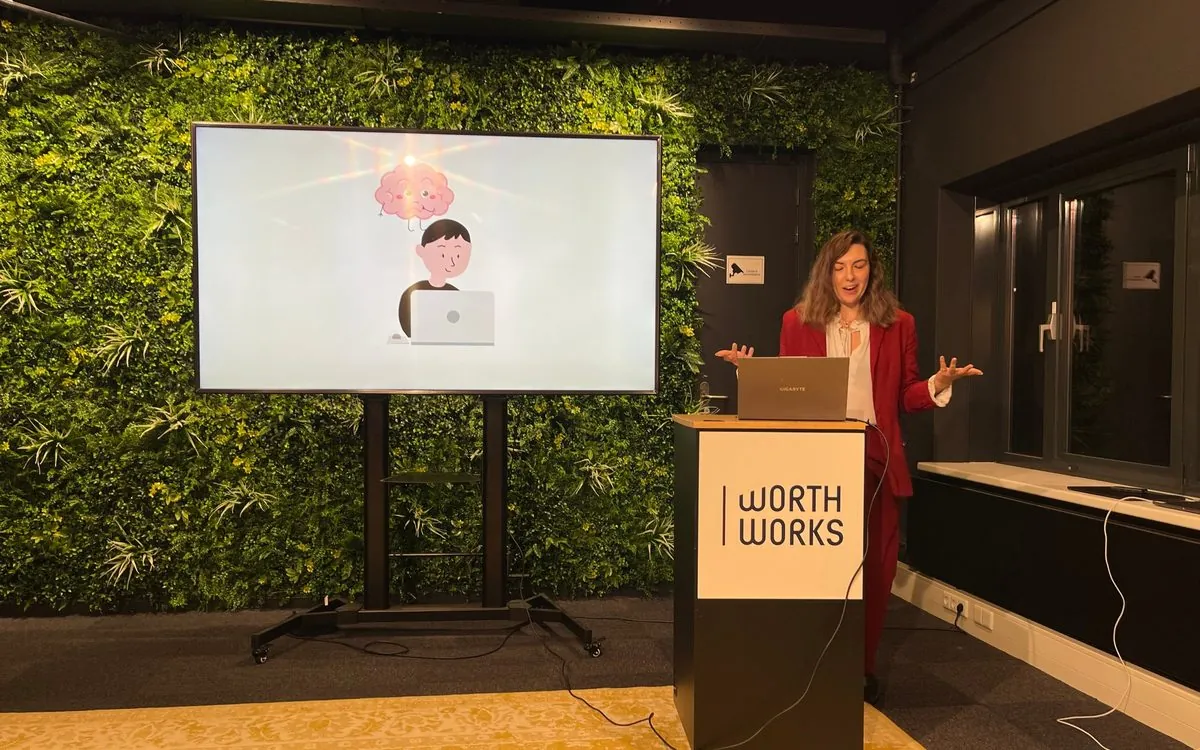
Talks and workshops
I make behavioral science practical for teams who build technology. No psychology background needed.
2026, Sensirion AG, Switzerland
Behavioral Science in Product Innovation
A one-hour training for sales and R&D teams, tailored to their own products, with tools they could use the next day.